Agricultural and Farm Fences in Knoxville TN
A farm fence can serve many purposes on your property. Its first and most important duty is to keep the appropriate animals on your land. With many rolling acres, wet soils, brush, tractor entrances, and loads of large and energetic animals on your farm, creating and maintaining a solid farm fence can be quite challenging!
AV Fence Knoxville installs agricultural and farm fencing on property around Knoxville. The farm fencing needs to be designed and installed with many variables in consideration including livestock, fields, water, sludge and more. For Knoxville the major variable is rain with an average annual rainfall of 52 inches. For this reason, fence post depth, fence bracing, and fence drainage are significant.
Agricultural & Farm Fencing We Install
Woven Wire / Field Fence
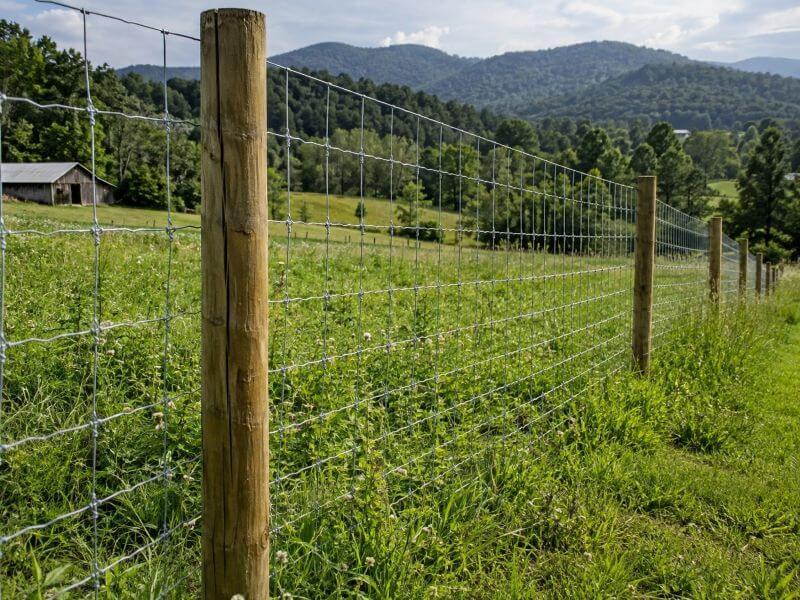
Woven wire is commonly used to contain small to medium sized animals such as sheep, goats, calves, and hogs. The mesh spacing should be matched to the individual animal, and the bottom of the fence should be set so that young stock cannot slip through or get their heads caught while trying to get through.
Design: Horizontal and vertical galvanized wires form a flexible mesh on wood or steel posts.
Common Height: About 4 to 5 feet.
These fences are made with Field fence, fixed-knot or non-climb wire, treated posts, T-posts, and braces.
Maintenance: Check for proper tension, damaged mesh or wires, poorly attached staples, weeds growing through the openings and various washouts along the posts and stays.
For horses, AV Fence can obtain a wide variety of non-climb woven wire with visible top boards. According to the University of Tennessee Extension’s Agriculture and Natural Resources Team, high-visibility horse fencing is best when top boards and mesh are clearly seen by animals.
High-Tensile Wire Fence
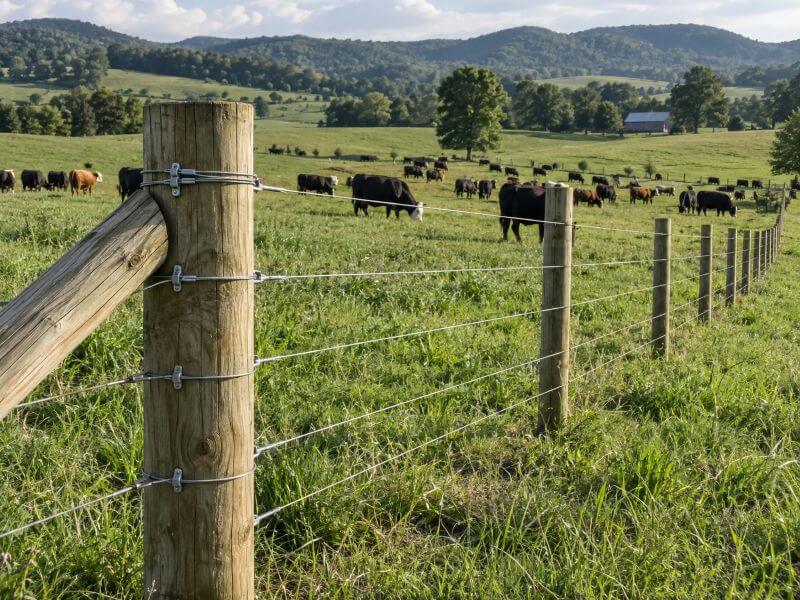
High-tensile wire is commonly used for pasturing large numbers of cattle and is often made electrified to give better control of cattle.
Design: Several wires of smooth surface are stretched between ends and corners of heavily braced terminal and corner posts.
Common Height: for larger cattle on pastures is about 4 feet to 4.5 feet high.
Materials: Galvanized wire, treated posts, strainers, insulators, and energizer (for electric fenced pastures).
Maintenance: Check voltage, cut grass around wires, check and repair insulators, check and tighten fence after storm.
High-tensile wire fencing is often made of thin wires to maximize strength, but those thin wires make very poor horse fencing because they are hard to see and there is always the danger of tangling with other fences unless they are made very visible.
Barbed Wire Fence
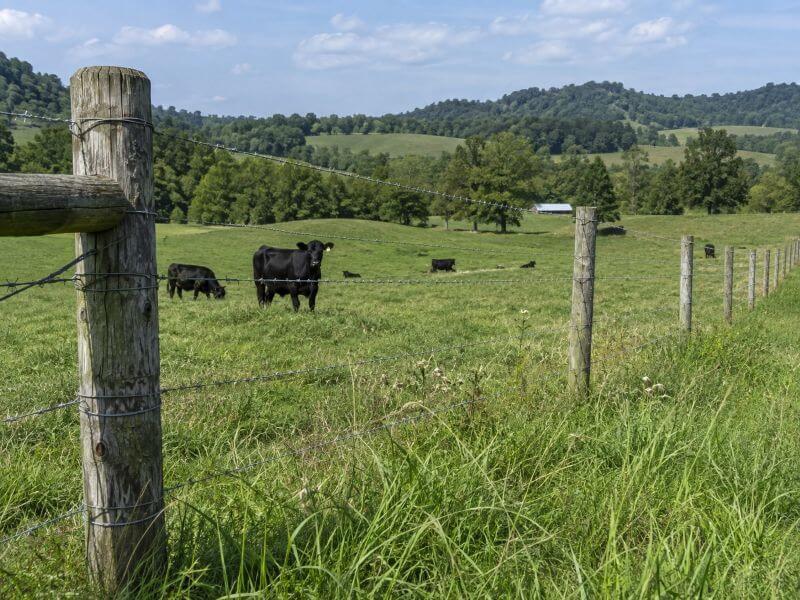
Although barbed wire is still widely used on larger cattle pastures, it is not recommended for certain species, including horses.
Design: Multiple strands of barbed wire suspended between posts made of wood or steel.
Typical Height: Four and one half feet or higher depending upon local state laws. The Tennessee department of agriculture specifies that a lawful five strand fence may have all strands equal in height or the top wire(s) must be at least four and one half feet above the lowest wire with all wires being at least seven feet above the ground.
Materials: Barbed wire, treated posts, T-posts, clips, staples, and braced corners.
Maintenance: Wire needs to be fixed from time to time and wire that has sagged needs to be tightened. The farmer must also clear branches from above the fence and make sure posts are secure.
UT does caution against the use of barbed wire for horses, plus the barbs cause severe problems with wooled sheep because their wool gets caught in the barbs.
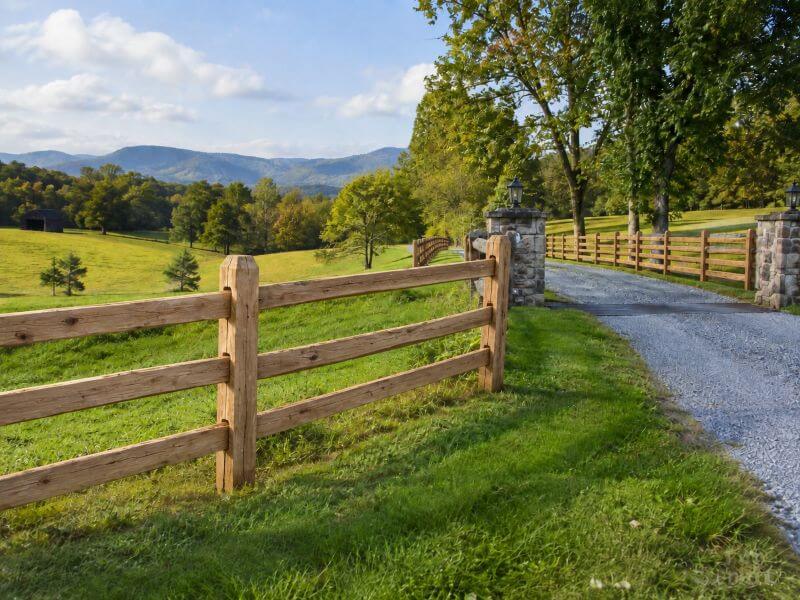
Split Rail Fence
Split rail fencing is used frequently for the perimeter of rural entrances, drives and property lines. In Tennessee, split rail fencing is found in the Corryton, Strawberry Plains, Powell and Tenn. roads around House Mountain areas.
Design: Split rail fencing is often used for entrance drives, property lines and in visible fencing around rural homes. It is often used in combination with fencing for larger pastures.
Common Height: About 3.5 to 4.5 feet.
Materials: Wood rails and posts, which are either treated or are naturally durable.
Maintenance: Rot, loose rail, insect infestation and shifting posts all can cause problems for Split Rail fencing.
Split rail fencing by itself is not suitable for containing goats, sheep and other small animals. You may want to add some wire mesh or offset electric wire for such animals.
Paddock Fence
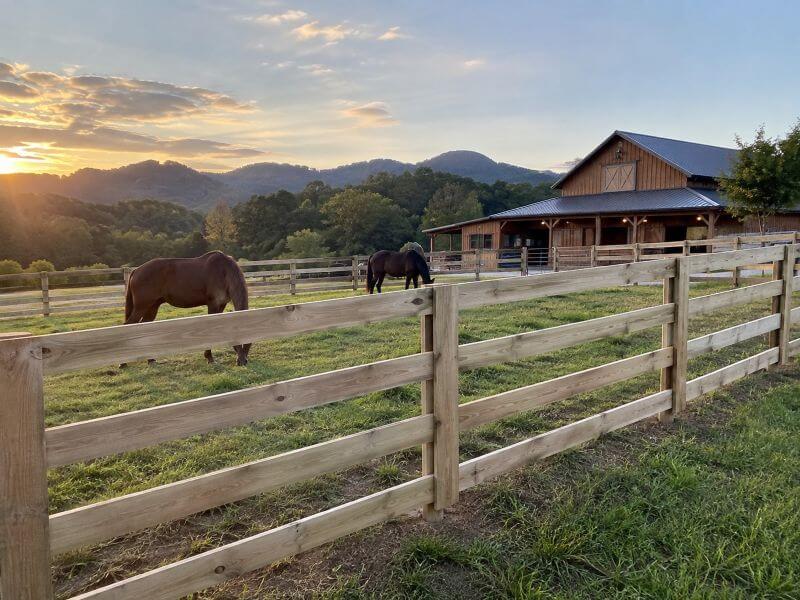
The paddock fence is an excellent fence for horses and cattle for smaller pastures, around barns and lanes.
Recommendation for Paddock Fence: There are typically three or four horizontal boards or rails of sturdy construction attached to the side of posts for a paddock fence.
Common Height: About 4 to 5 feet.
Materials: Treated lumber and posts. Exterior type fasteners. Optional electric offset wire.
Maintenance: Replace worn, cracked boards; reset leaning posts; check tightness of fasteners; clean or repair chewing damage.
Board fencing costs more than wire fencing but is very attractive to horse property owners. Horse owners like board fencing because the fence is visible to the horses and is very strong. UT Extension rates board fencing as ideal horse fencing.
Vinyl Ranch Rail Fence
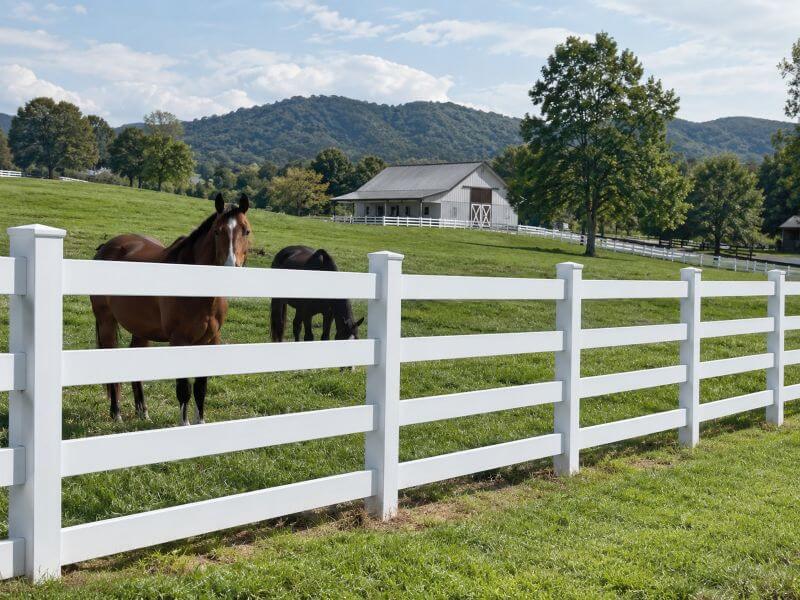
Vinyl ranch rail fence is a great option for those horse farms and rural homes. There is less painting and staining with vinyl than there would be with a wooden fence.
The three or four vinyl rails are locked into the routed posts to form the design of the vinyl ranch rail fencing.
Common Height: About 4 to 5 feet.
Materials: UV-resistant vinyl posts and rails, concrete to set posts at corners and low areas, electric wire for offset installation (optional).
Maintenance: Clean vinyl fence with soap and water to remove dirt and algae. Occasionally inspect damaged fence rails and posts for movement after accidents.
Hard hits can cause the vinyl to crack, and fences affected by pushing animals need to be protected by an electric strand to distribute pressure to the rails.
Farm Fencing for Knoxville Conditions
Slopes, channels or low areas with wet ground, brushy lots or numerous tree branches are common characteristics of a Knoxville-area farm. Corner braces in soft soils or gates placed in mud are typical chronic problems with fencing.
We service farms and rural homes near Karns, Hardin Valley, Powell, Corryton and Strawberry Plains. Special consideration can be given to fence design on steeply sloped fields. Corner strength can be improved upon, and gates placed in low areas can be constructed on higher sites adjacent to fields.
Frequently Asked Questions
What is the best farm fence for cattle?
There are many types of farm fencing that can be used to protect cattle. Woven wire fencing, high-tensile wire fencing, barbed wire fencing and rail fencing all can be used for farm fencing. When choosing fencing for the farm it is best to consider how many acres you have, how much pressure the cattle will put on the fence, how much you can spend, and whether the fence will be a perimeter fence or be used for cross fencing.
What fence is best for goats and sheep?
Smaller lower opening woven wire fence is best for goats and sheep. Electric wire can be added to make control of animals and protection from predators even better.
How high should a livestock fence be in Tennessee?
These minimum heights will qualify for funding through the 2026-2027 Agricultural Enhancement Program for Tennessee.
Are Agricultural Fences regulated by the city of Knoxville?
Within the Knoxville city limits, single-course fences not exceeding 7 feet in height may be exempt from a building permit, however the work may be required to be reviewed by the city and may be subject to additional requirements or special conditions.
What fence should I avoid for horses?
Barbed wire and high-tensile wire fences can be hazardous to horses, often resulting in serious lacerations. Thin, high-tensile wire needs to be made visible with surface supports. Care should also be taken in designing fences of this type to guide horses safely should they encounter the wire.
How often should farm fencing be inspected?
Major weather events, as well as several inspections throughout the growing season, will reveal weaknesses in your perimeter fencing. Check corners, gates, low areas, electrical components and high wear points.
Call AV Fence Knoxville for Agricultural and Farm Fencing
For a new pasture fence, livestock enclosure, or cross-fencing for your farm, or even a replacement farm fence for your Knoxville property, call, text, or email AV Fence Knoxville to schedule your agricultural and farm fencing free on-site evaluation and consultation.